Image

Lifelong Learning

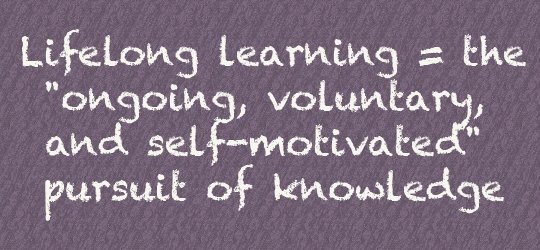
Lifelong learning is interpreted as engaging people with learning throughout all stages of their lives. Lifelong learning has been interpreted in many ways over the years, ranging from ‘second chance’ education to linking secondary or tertiary education with industry. So how can schools help students to become lifelong learners? Students need to remain engaged in learning and develop characteristics that will make learning an enjoyable and integral part of their lives for when they leave school.

As a ‘mature age’ student my motive for learning is to enhance job prospects. I didn’t overly enjoy learning at high school however I have a renewed respect for learning and I am far more curious than I once was.  The emphasis on curiosity is a classic lifelong learning characteristic, to ‘find out more’, ‘for my own inner development’. It indicates an enjoyment of learning and an expectation to keep on learning.
timthumb.php


Image

The Digital Divide

The digital divide is unfortunately a growing concern in today’s society. For students who are not privileged by having the Internet or a computer at home are at a huge disadvantage. Some students have to spend their lunch times in a classroom or are staying back after school to complete homework or assignments that are wholly dependent on technology. The speed in which we are moving forward with by integrating technology into our education has put a number of students at a huge disadvantage and this is not very fair. There are some schools that are also insisting that students bring their own devices to school rather than the school providing them, which is putting an even bigger strain on household budgets, especially when there is more than 1 child.

There is also evidence that there is a growing digital divide between parents and technology. Prior to the digital world, parents’ biggest concern was being able to help their children with their homework. Nowadays parents have to become digitally fluent and for some parents who have little or no exposure to technology that can be even more difficult. Not to mention the fear parents also have of cyber bullying or cyber stalking. There are many social media platforms that children have access to that make them so much vulnerable.

Infographic